A pessimistic take on human in the loop
Human reviewers buy us safety margins. But they can also become permanent blockers.
Sometimes, human in the loop just means I, Human, will personally stand as the blocking bottleneck in this process. I will ensure we never get the promised efficiency gains, speed, and optimizations we hoped to build with this AI system. I will stay in this loop and create a pileup, until I get fed up and lazily start mass-approving the incoming requests. I will then blame AI for mistakes.
How do we not do that? We tout HITL as a safety mechanism for many of our customer projects, but how do we know we're not setting them up for sure disappointment down the line?
A thought: if we propose a system where HITL is a core safety mechanism — our answer to an RAI concern, our "let's do this, we're good because we have a HITL" — we should also be designing the path to get that human out of the loop, eventually. What is the offramp for this person? What things need to improve, what things need to be built, what validations need to be observed for us to safely get this person out? Or move them to a different part of the RACI matrix? Does the business process fundamentally need to change (see examples below)?
I think we will do a disservice to customers if we create systems that are fragile and solely held together by a person keeping their finger on every action the system takes. Maybe it's fine as today's answer (to kickstart AI adoption), but we should think of it as a temporary state.
All of the below transitions sounded wild at first. "How could you not have a human in this process? Of course we must." But for all of these, going back to having a human in the loop sounds absolutely ridiculous. Walk with me, just for fun:
- Email spam filtering: in 1998, a startup named Bright Light raised $55 million with the genius idea of having human operators filter and "end spam." Today, Gmail filters 99.9% of all spam automatically. Backup: in the case of mistakes or misses, there is a "report spam" action for users to take, which feeds into a system that improves the spam detection model. Source
- Hate speech in social media: In 2017, Meta was only able to catch ~20% of hateful content proactively, and the rest would be reviewed manually after posting. Today, Meta captures 95% of hate speech before publishing. Backup: for the 5% "borderline" posts, they route to a large internal team to review. They handle escalations, appeals, and auditing reconciliations after the fact. Source
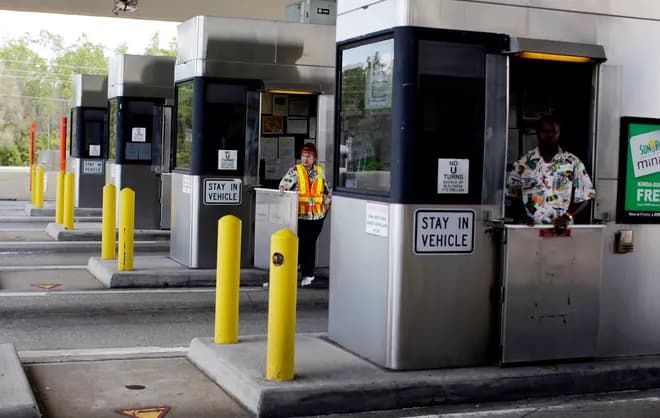
- Highway tolls: For 60+ years in New York, roads and bridges collected tolls with a human operator working a toll gate barrier. As of 2020, most of New York's toll roads are cashless, and many are booth-less entirely. Backup: cars that pass without an E-ZPass are sent bills via mail, which are then escalated to the DMV, and are escalated to collection agencies to close revenue gaps. Source
- Check clearing: When you deposit a check at the bank, the bank would have to drive that check to the Federal Reserve or a corresponding bank clearing center to balance, sort, and credit/debit the right accounts. This happened until 2004 (that's insane), when Congress passed the Check 21 Act, which allowed banks to send each other digital scans of the checks for reconciliation. Backup: there is a risk of duplicates and mismatches, so the banks run duplicate detection and similar anomaly detection algorithms to flag and reconcile appropriately. Source
These are just a few cases in history where we thought processes were so precious and could not be void of human intervention, and were. The key takeaway here is that none of these processes pretended the automated path was going to be perfect. They all incorporate processes for slippage, a phrase I use here to capture "any mistake that requires a reconciliation, review, or escalation, that was not on the designed happy path." Slippage is fine. Just account for it in the system. Maybe even with a human.
After writing this, actually, I think this is an optimistic take on how we've successfully and carefully removed humans from processes they shouldn't be in. From the loops they were in, where they caused bottlenecks that were no longer necessary. Maybe we can do the same in the LLM-based systems we build today.